

Global VAT professional, elected Labour councillor, maker of focus music for Neurodivergent brains, and writer about whatever's currently occupying the hyperfocus slot. AuDHD. Based in Burntwood.
In Defence of the Neurodivergent Mask
Last week I saw an Instagram past about masking and Autism/ADHD/AuDHD. The main point was simple: masking starts when a neuropergent kid realises being themselves causes trouble. The brain adapts. By the time you're an adult, the mask and the real person blur together. The post said the real cost of late diagnosis isn't just missing out on support. It's the grief of realising the version of you everyone knows is something you built to survive.
It's a strong argument. I get where they're coming from, and I wouldn’t wish to question their experience.
But I think many autistic people talk about masking like it's only a wound. For me, it's more complicated.
When, at the age of 49 (or was it 50? I’ve lost track), I first got my AuDHD diagnosis, I didn't think I masked at all. I mean, I called myself a social chameleon because my language and mannerisms changed to suit the context of my situation. It took me a lot longer than it should have to realise that's just another way of describing masking.
Four years on from diagnosis, I've settled into myself. I don't mask as much. So, I probably look more obviously neuropergent now. And, I'm fine with that. If anything, I hope it helps other people feel like they can be themselves, too.
But the bit I think is missed in the discussions I’ve read is: the masks I've created for myself over the years aren't just coping mechanisms that I'd be better off without. Many of them are positive things for me. Some of them I actively like.
Masking is probably a big part of why I'm good at my job. Once I figured out how business meetings worked and built a mask for that, I got better at negotiations and big discussions. The mask didn't get in the way. It made it possible.
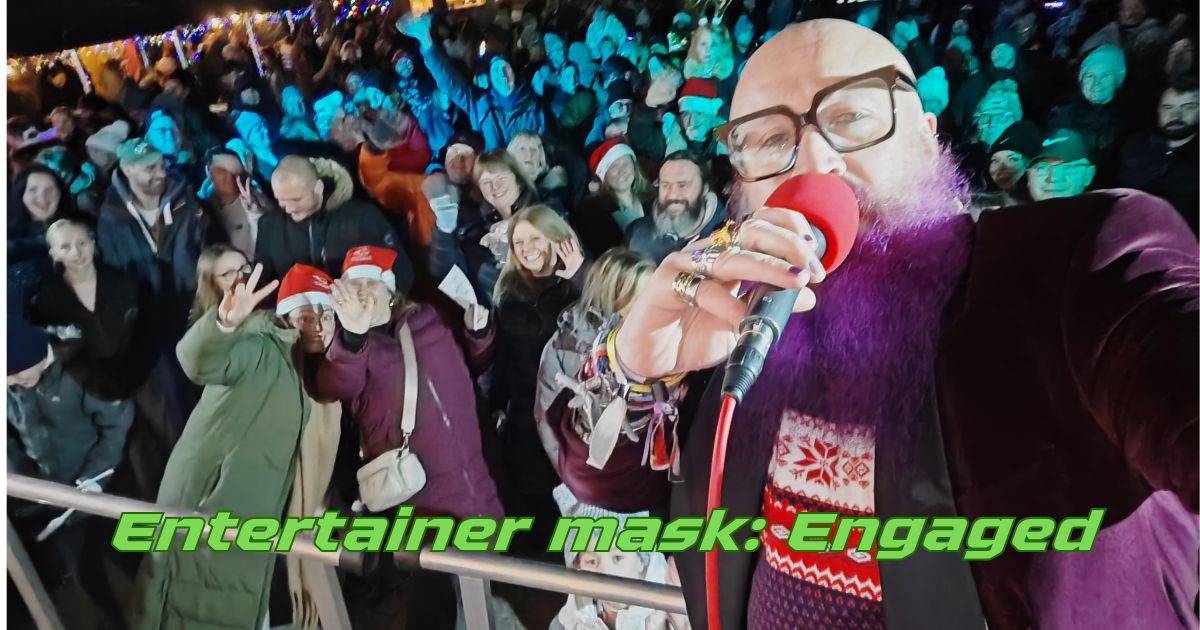
Lately, I've been presenting on Lichfield Radio and doing music DJ livestreams. What makes that fun, and what makes me decent at it, is an entertainer mask I built over thirty years as a mobile DJ. That version of me actually enjoys being on. It switches on, does the job, and has a good time. Next weekend I'm hosting the start and finish line at a 5km and 10km run in Tamworth. I've never done that before, but it’s similar enough to the DJing and live stuff I’ve done that I'm confident the mask will show up, and it'll be fine.
There's even a Council meeting mask. It turns up, it contributes, it fires up the synapses to handle the cut-and-thrust of things that come up mid-debate without completely falling apart. I'm still slightly surprised by it every time.
More recently, I've noticed something I don't fully understand. Most of my masks, or the people I am when those masks slip on, aren't depressed. The underlying me often is. I can't explain the how or why. I just know that when a mask fires up, something shifts. The relief is I get might be temporary, but it’s genuine. I value it.
There is a cost to masking though, which the Instagram post was right about. Masks are tiring. They will sap the physical, emotional and social energy like a…. like a [insert energy sapping thing here. It’s late, and I’m tired.] When they come off, I often have no socialising left in me for a while. Reasonably often, I have to step away from a social situation for a while to hide in a quiet room and recharge. MrsVark has come to recognise when this is happening and smooth things over.
But I'd be genuinely bereft if I ever became so authentically, unguardedly my neuropergent self that the masks stopped working. They're not a corruption of who I am. They're a facet of who I am. Both the good and the bad.
I don't grieve for what might have been if I'd been diagnosed as a child. The understanding simply wasn't there until relatively recently. Being upset about it feels roughly like being annoyed you couldn't watch the Marvel films as a kid — they're a product of their time, and you can only experience them in the time that made them possible.
What I do think is worth grieving — and what the Instagram post was pointing at, even if I'd push back on some of its conclusions — is the difference between wearing a mask you understand and wearing one you don't know you have. The harm of late diagnosis isn't that masking happened. It's that it happened without understanding, and without the option to choose. One of those is a tool. The other is a trap you didn't know you were in.

